The Front de Seine looks like nowhere else in the 15th. Along the Seine, across the Javel and Grenelle districts, around twenty residential and office towers, close to 100 metres tall, rise above a pedestrian podium. Letting a flat in one of them for short stays takes a little more preparation than a flat on an ordinary street. Here is what to look at.
A district built on a podium, in two waves
Work began in 1967 with the Keller complex in the south, and the district was only finished in 1990 with the Tour Cristal. In between came towers such as Mirabeau, Totem, Beaugrenelle and Avant-Seine. From 2005, the podium was renovated block by block: waterproofing, gardens, lighting, footpaths from one end to the other and the car parks underneath brought up to date. The Beaugrenelle shopping centre reopened in October 2013.
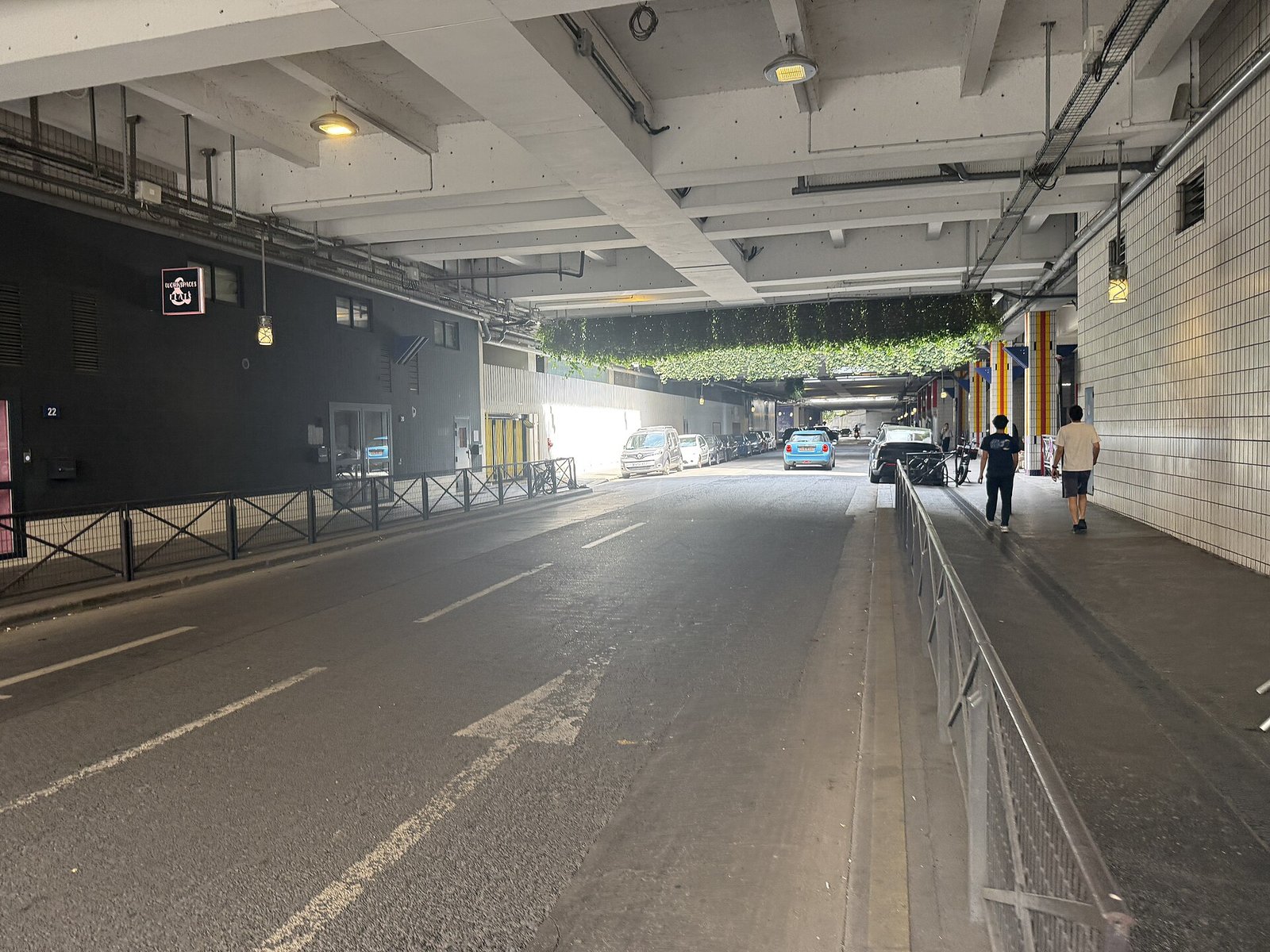
Covered streets run beneath the podium, such as rue Robert-de-Flers in the photo. For a guest arriving for the first time, this matters: the street the satnav shows is not always where the entrance is, and the lobby may be up on the podium. The area is served by Javel-André Citroën station on metro line 10 and by Javel station on the RER C. Our page on Beaugrenelle and Front de Seine describes the area.
The building’s rules come first
Each tower has its own co-ownership rules (the règlement de copropriété), and that document decides what is allowed. Paris city hall makes the point on its own website: a furnished tourist let must comply with the building’s co-ownership rules. We cannot tell you what yours say. Before the flat goes online, the simplest step is to reread them and talk to the managing agent (the syndic), in particular about three things:
- key boxes: are they allowed in the lobby or on the podium?
- badges: how many do you have, and can an extra one be made?
- house rules: quiet hours, bin store, parking, whether there is a caretaker
On the City’s side, council decision 2025 DLH 44 (article 7 bis) requires a prior declaration for any furnished flat let for short stays, which gives you a registration number. According to paris.fr, that number must appear on your listings, and a main home can be let for up to 90 days a year.
Access and key handover
In a tower, the arrival often plays out before the guest even reaches the flat’s door: finding the right lobby, getting through the access control, taking the right lift. We write step-by-step instructions with photos of the entrance and send them before the day. If the badge cannot be left in a key box, we arrange to hand it over in person. On departure, the badge and keys are collected and checked every time. Our check-in and check-out page has the details.
Cleaning and the shared areas
Taking linen and equipment up in a shared lift, taking the bins down to the right store, keeping to the building’s hours: all of this is worked out once, then repeated at every changeover. We record it in the flat’s file so that the cleaning team follows the same rules on every visit, and so that the neighbours have no reason to complain to the syndic.
Frequently asked questions
Can a Front de Seine tower flat be let for short stays?
That depends first on the tower’s co-ownership rules. According to paris.fr, a furnished tourist let must comply with them: reread yours and talk to the syndic.
Do I need to declare the flat to the City of Paris?
Yes. Council decision 2025 DLH 44 requires a prior declaration, which gives a registration number to show on your listings.
How does the guest find the entrance to the tower?
Before they arrive, we send step-by-step instructions with photos of the right lobby and the way in from the podium.
What if the badge cannot be left in a key box?
We hand it over in person on arrival and collect it on departure.
Photo: Chabe01, CC BY-SA 4.0, via Wikimedia Commons